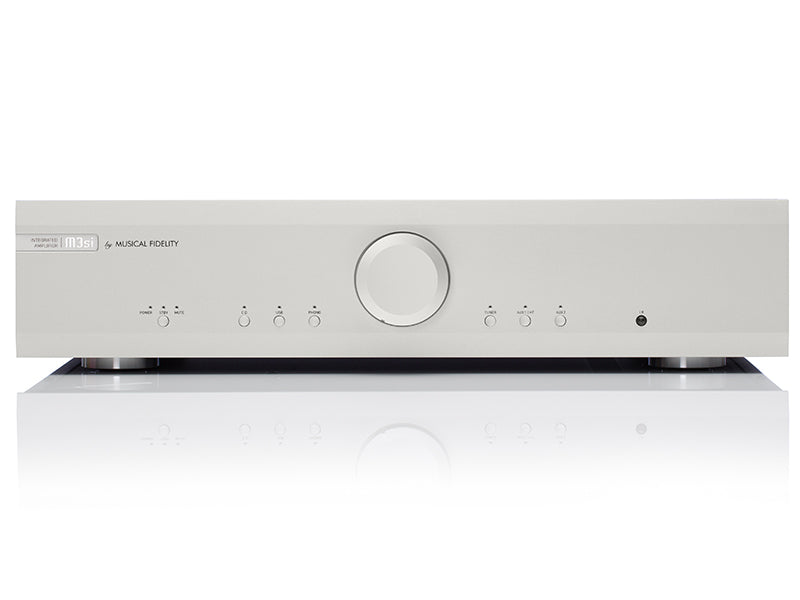
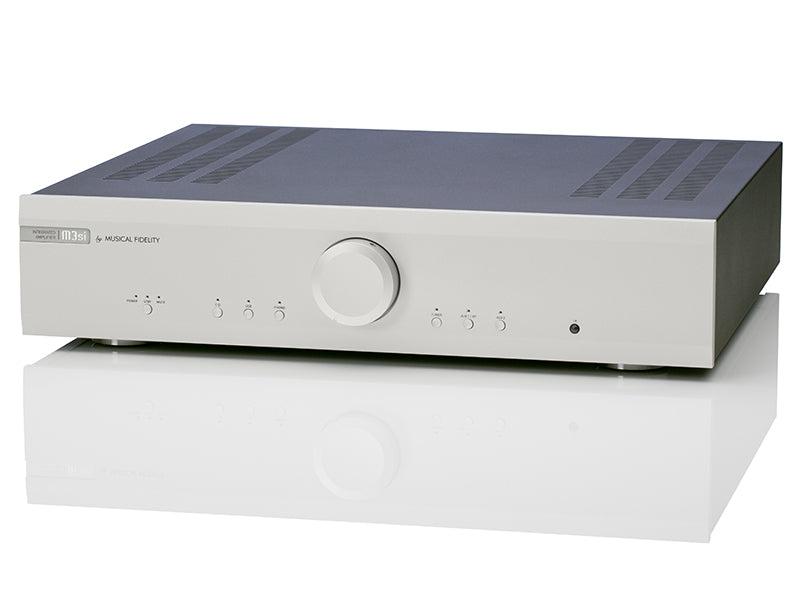
More useful inputs without becoming an all-in-one receiver
M3si provides 2x85 W, MM phono and asynchronous USB-B for a mixed analogue and computer-audio system.
M3si sits above the M2 range for listeners wanting a still-compact amplifier already prepared for an MM turntable and computer audio. Its 85 W per channel suits a broad choice of standmount or floorstanding loudspeakers in medium rooms, while asynchronous USB-B up to 24-bit/96kHz avoids a separate interface for direct PC or Mac connection. It includes no streaming, Bluetooth or HDMI: this remains a hi-fi integrated amplifier, not a network receiver.
Key features
- 2x85 W into 8 ohms
- Four RCA line inputs
- MM phono input
- Asynchronous USB-B up to 24-bit/96kHz
- SMD layout and separate supply capacitance for each channel
- Pre out for external power amplifier or active subwoofer
The right step for a hybrid system
Compared with M2si, M3si adds two sources that often define a real system: turntable and computer. The MM phono input handles moving-magnet and high-output MC cartridges; asynchronous USB-B takes control of timing rather than relying on the computer clock, reducing jitter. Anyone mainly using a television and Bluetooth will find M2xi more immediate; M3si prioritises dedicated hi-fi listening.
Eighty-five watts with channel separation
The SMD layout reduces circuit area and creates room for power-supply capacitors dedicated to each channel. This arrangement supports dynamics and limits interaction between left and right, important for stable stereo images and controlled bass. M3si does not chase M5xi's 160 W: it serves normally sensitive speakers and rooms needing authority rather than an oversized reserve.
What can grow around M3si
The pre output allows an active subwoofer, bi-amping or an external power amplifier while retaining M3si's inputs and volume control. A separate DAC can feed a line input when 24/96 is insufficient, and a streamer connects through its analogue output. This modular route prevents the entire amplifier becoming obsolete when only the way digital music is accessed changes.