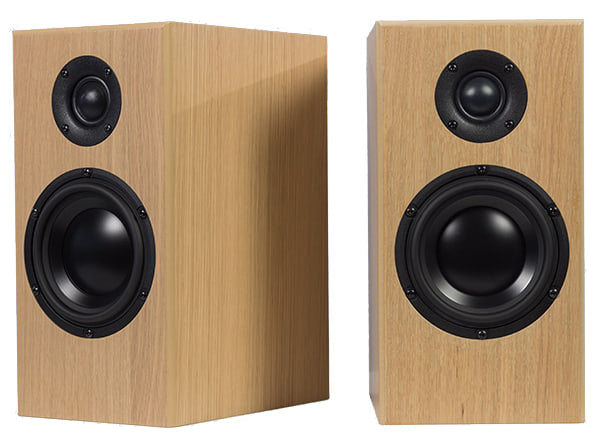
The Bison family in standmount form, with stated 40 Hz extension
Totem Bison Monitor is a two-way standmount loudspeaker with a 5.25-inch woofer, 1.3-inch textile tweeter and 8-ohm impedance.
It is the Bison model for listeners wanting the same driver, cabinet and crossover philosophy in a more compact format. Response reaches 40 Hz and recommended power tops out at 150 W, allowing it to work in serious stereo systems without requiring the physical volume and wall clearance associated with a floorstander.
Key features
- Two-way standmount architecture with reflex loading.
- 5.25-inch long-throw woofer with a 3-inch voice coil.
- Proprietary 1.3-inch laser-etched textile tweeter.
- Specified frequency response of 40 Hz-29.5 kHz ±3 dB.
- 87 dB sensitivity and 8-ohm nominal impedance.
- Amplifier range specified at 30-150 W.
- First-order crossover network centred on 2.5 kHz.
- Four-way terminals supporting bi-wiring.
A small cabinet with a large voice coil
The mid/bass driver uses a 3-inch voice coil, substantial relative to cone diameter. This increases thermal capacity and mechanical control without turning the monitor into a difficult electrical load. Lock-miter construction, internal bracing and borosilicate damping complete an enclosure designed to limit repetitive resonances.
Monitor or Tower
Bison Tower extends deeper and needs no stand, but occupies more vertical space. The Monitor is easier to place and can sit closer to the rear wall while preserving the same 8-ohm family character. It is therefore appropriate where the room favours a compact loudspeaker without moving to a less ambitious range.
Room and system matching
Totem specifies roughly 15-90 cm from the rear wall and 90-300 cm between speakers. It suits small and medium rooms, or advanced nearfield systems, provided it is placed on rigid stands. The 8-ohm impedance allows broad compatibility with good integrated and power amplifiers. At roughly 13.5 kg, mass is substantial for an enclosure of this size and reflects a more serious structure than a typical bookshelf model. In practice it deserves rigid, suitably strong stands that keep the cabinet stable and at the correct listening height. The wide specified spacing range also leaves useful freedom when balancing image width against centre focus.