Twenty-five watts of pure Class A, chosen for how they operate
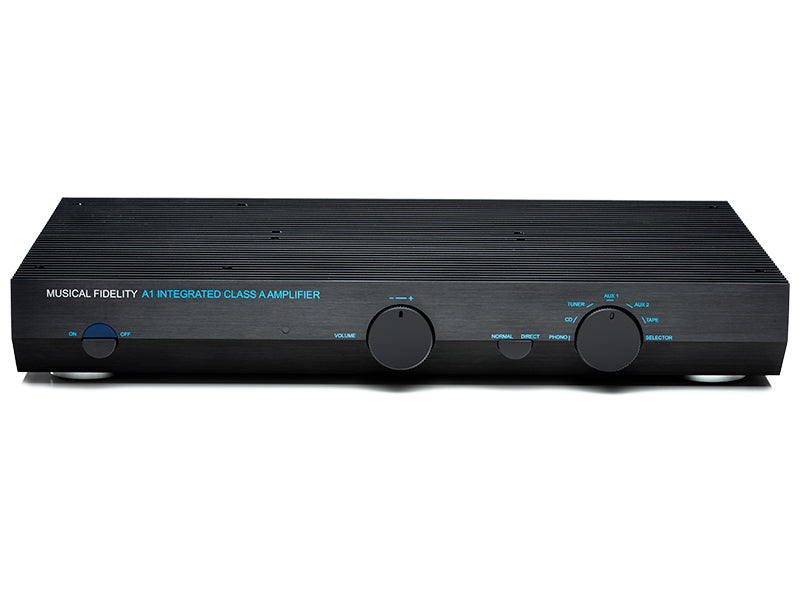
A1 is a 2x25 W Class A analogue integrated amplifier with dual-mono power and MM/MC phono input.
A1 does not compete with the other integrated amplifiers in this group by counting watts or digital inputs. Its purpose is Class A bias: the output stage works without the switching behaviour typical of Class A/B, accepting heat and limited power in exchange for continuity. It belongs in an analogue system with efficient loudspeakers and a suitably sized room; choosing A1 starts by checking sensitivity, impedance and listening distance.
Key features
- Class A amplification, 2x25 W into 8 ohms
- Fully discrete symmetrical circuitry
- Low-noise JFET preamplifier
- Toroidal transformer with dual-mono windings
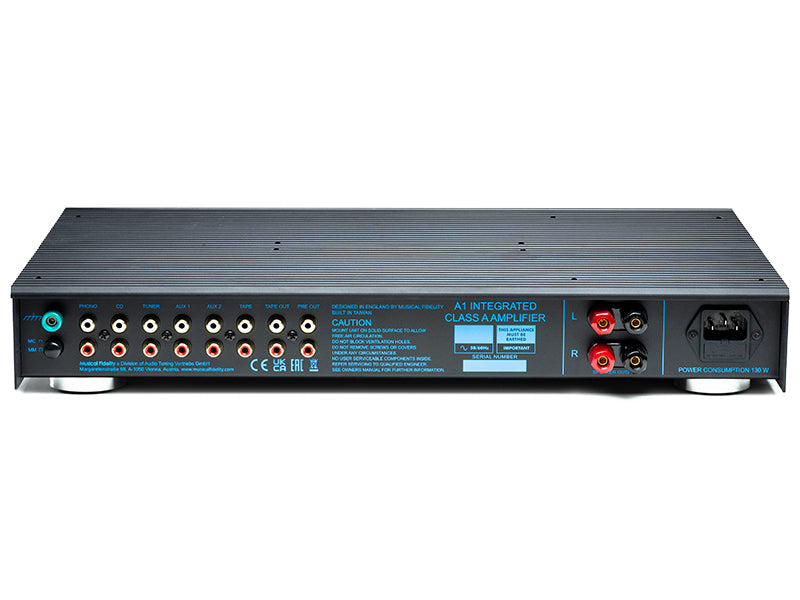
- Five line inputs and MM/MC phono stage
- Alps potentiometer, pre out and remote control
Class A comes before wattage
The output transistors remain active throughout the signal cycle. This avoids the handover region between devices found in many A/B designs, but dissipates energy even without music. A1 needs open ventilation rather than a closed cabinet. Its 25 W are not an abstract limitation: they become sufficient with benign, efficient speakers and realistic levels, but less so with difficult loads or a large room.
An amplifier for analogue sources
Five RCA inputs leave room for a player, a streamer with external DAC, a recorder and other line sources. The phono stage accepts both MM and MC cartridges, allowing a turntable to connect without another box. The absence of HDMI, Bluetooth and an internal DAC deliberately separates A1 from B1xi or M2xi: here the budget is concentrated on the analogue path and power supply.
Separate channels from the power supply onwards
Dual-mono windings and independent supply stages reduce interaction between left and right. Polypropylene capacitors, metal-film resistors and the Alps control follow the same principle of a selected, purposeful circuit. The pre output can feed a power amplifier or active subwoofer, but does not change A1's character: this remains a choice about system matching rather than brute force.