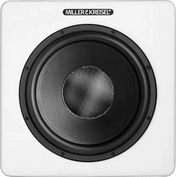
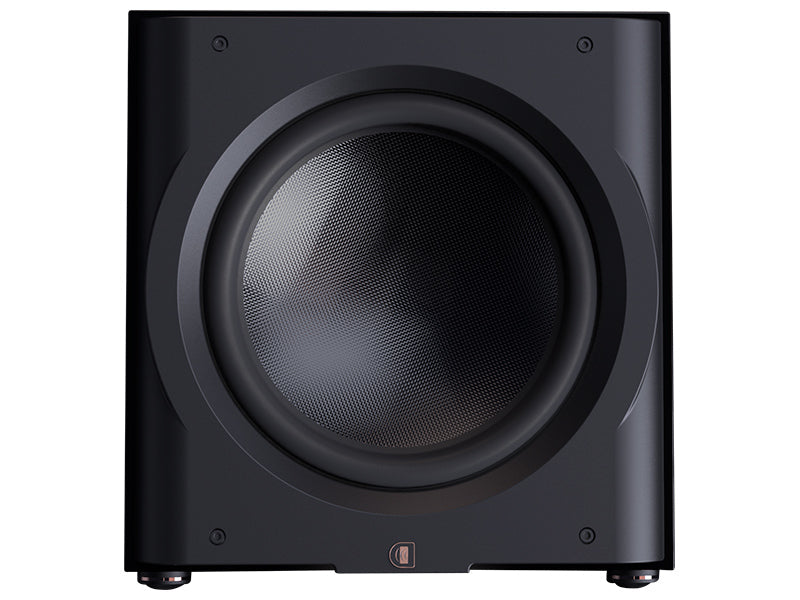
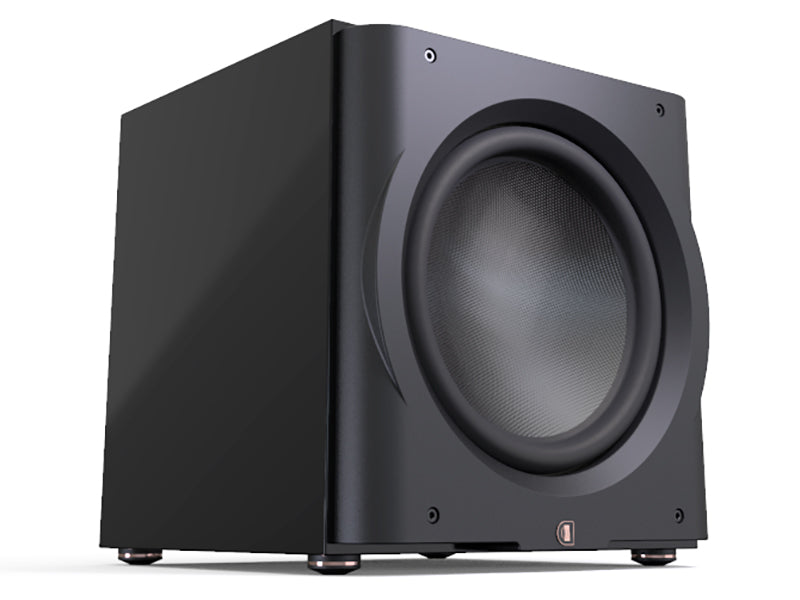
D15s: large-scale impact from one premium transducer
The D15s is for listeners wanting the authority of a 380 mm driver without the complexity and mass of a push-pull arrangement.
It suits a medium-to-large room or an ambitious stereo system in which bass must have weight and natural scale. Its 2000 W amplifier and carbon-fibre cone clearly separate it from the R15s: the nominal diameter is the same, but headroom, diaphragm rigidity and performance objectives differ.
Key features
- 380 mm woofer with carbon-fibre cone
- Single-driver acoustic-suspension design
- 2000 W amplification
- THX Dominus
- 528 x 500 x 500 mm; 46 kg
- Piano Black
Who needs the D-Series 15-inch model?
The D15s is for realistic listening levels and for anyone wanting to feel the weight of the lowest octaves without turning the room into a technical space. Its single driver simplifies size and placement compared with the D212s and D215s, while the 380 mm radiating surface produces a sense of scale that asks more excursion and effort from the D12s.
The same diameter as R15s, a different design
The most useful comparison is with the R15s. The R Series uses glass fibre and 1000 W; here carbon fibre and 2000 W are intended to preserve control as excursion and output rise. The price difference is therefore not a badge: it reflects diaphragm material, electrical reserve, THX Dominus certification and the ability to sustain more severe demands.
Music: mass without blurring rhythm
With double bass, electronic music and organ, the large driver is not about bloated bass but about reproducing deep fundamentals without excessive stress. The sealed enclosure supports orderly decay; correct calibration should preserve the handover to the main loudspeakers, preventing the subwoofer from becoming localisable or dominating the lower midrange.
Cinema: energy through sustained peaks
In films, the D15s earns its place when explosions, engines and ambience must retain substance after the first impact. Its 2000 W amplifier supplies the margin to control the cone through dense sequences. Very large rooms or several rows point towards the D212s or D215s; in a substantial domestic cinema this model often avoids overspecification.
Digital control in one line
32-bit processing, 48-bit DSP, 10-band equalisation with three presets, 0-270-degree phase, RCA/XLR, display, app and 12 V trigger repeat the D platform described on the D215s. On the D15s they are principally tools for managing room modes and creating separate music and cinema profiles.
D15s or D12s?
The D12s is easier to accommodate, lighter and preferable when footprint and wall proximity are decisive. Choose the D15s when the room accepts a half-metre enclosure and the listener wants more radiating area, less perceived compression and a more physical presentation. It is not automatically better: it serves a different objective.