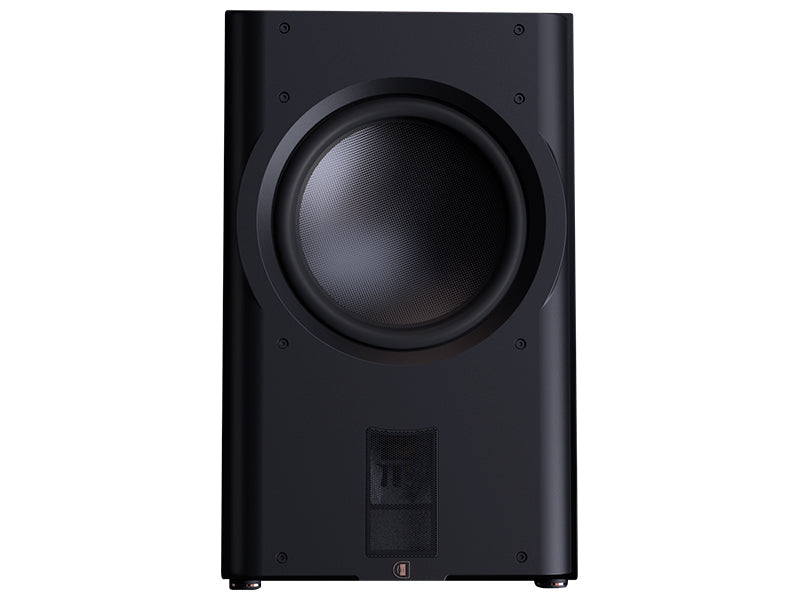
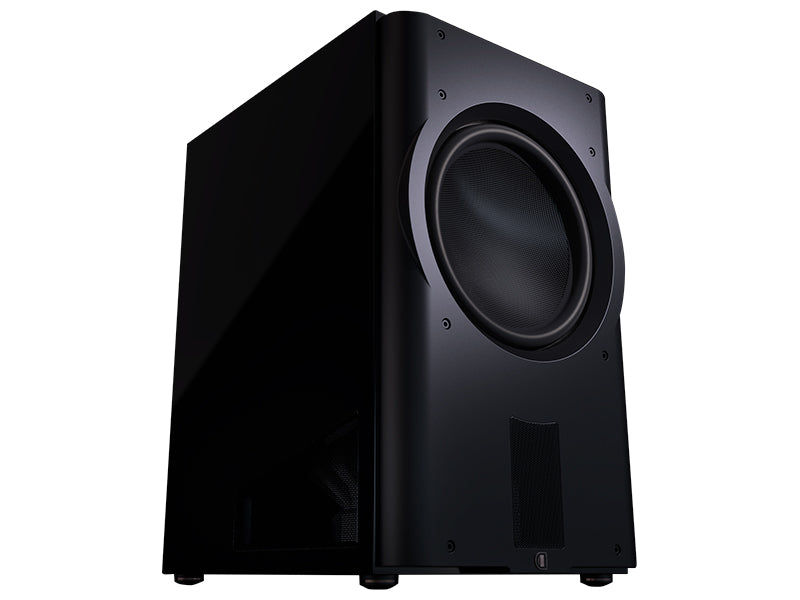
D215s: the subwoofer for rooms where scale cannot be simulated
The Perlisten D215s sits at the top of the D Series, intended for systems that must retain dynamics, depth and definition in genuinely large spaces.
It is not merely an enlarged D212s. Its two 380 mm drivers, 3000 W amplifier and enclosure volume reduce compression as listening distance increases and soundtracks demand sustained energy below 30 Hz. It belongs in reference private cinemas, rather than being used to overwhelm a small room with surplus output.
Key features
- Two 380 mm woofers with carbon-fibre cones
- Push-pull acoustic-suspension alignment
- 3000 W amplification
- THX Dominus certification
- 805 x 500 x 650.5 mm; 92 kg
- Piano Black finish
When the D215s makes sense
Its natural setting is a large dedicated room, with several seating rows or a substantial listening distance. The greater radiating area of the two 15-inch drivers is not simply about playing louder: it reduces the effort required for a given output and retains headroom through long, complex passages. In a high-level multichannel design it can become the foundation around which the entire low-frequency system is sized.
Push-pull means lower distortion
The two transducers operate in mechanical opposition. This arrangement suppresses even-order harmonic components and reduces forces transferred to the enclosure, improving attack definition and bass stability. That is the technical reason to choose it over a single-driver model when high output is needed without giving up articulation.
The complete D-Series control platform
The D215s is the right model on which to describe the shared platform in full: a 32-bit ARM Cortex M4 processor, 48-bit DSP data paths, RCA and XLR inputs and outputs, variable phase from 0 to 270 degrees, invertible polarity, low-pass filtering and a 10-band parametric equaliser with three presets. A 2.4-inch LCD touchscreen, iOS and Android app, automatic turn-on and 12 V trigger bring calibration and daily control into one ecosystem.
Carbon fibre and dynamic headroom
Carbon fibre defines the D Series and separates the D215s from the R family. Diaphragm rigidity helps the piston retain its shape through demanding excursions; motors, shorting rings and suspensions are optimised through non-linear modelling and Klippel laser measurements. The 3000 W figure is therefore not decoration, but the reserve required to control two large moving assemblies.
One subwoofer or several?
Even with this much capability, in-room response remains governed by room modes. Two D215s are not automatically about extra loudness: they may be deployed to improve bass consistency across several seats. The decision between one unit and a multiple-subwoofer layout should follow acoustic measurement, room geometry and the objectives of the design.
Why not choose the D212s?
The D212s is easier to place and already extremely capable. The D215s becomes rational when room volume, listening distance or audience size demand greater displacement and less compression at peaks. Without those conditions the smaller model may be better balanced; with them, the D215s supplies the physical scale that makes explosions, organ and large orchestral forces convincing.