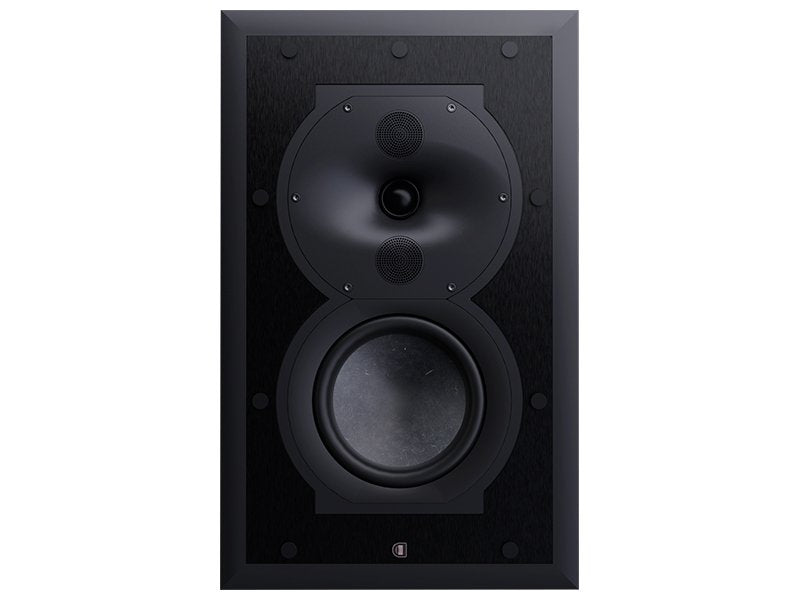
R4i-LCRS: the Reference utility player for front and surround channels
The R4i-LCRS can act as left, centre, right or surround; its strength is building coherent systems from one in-wall module.
Its short format and single 165 mm woofer fit walls that cannot accept R5i models and allow the same opening to be repeated across channels. It is the Reference choice for compact rooms, complete layouts or installations where flexibility and consistency outweigh maximum output.
Key features
- 3-way in-wall loudspeaker
- DPC Array with three 26 mm silk domes
- 165 mm HPF woofer
- 50-200 W; 4 ohms; 88.8 dB
- 438 x 257 x 101.7 mm cut-out; 11.2 kg
- THX Ultra LCR and THX Dominus Surround
One model across three system zones
A front trio can be followed by identical modules on the flanks and rear. Repeating one footprint streamlines preparation, servicing and voicing while preserving a uniform perimeter signature. As a main speaker it needs subwoofers and sensible distances; as a surround it exploits controlled dispersion and dedicated Dominus certification.
Its advantage over the R5i
The R5i-LR and R5i-C provide two woofers and greater front-channel margin, but need longer openings and two orientations. The R4i-LCRS gives up some capacity to cover more roles. It is right where the wall dictates format or where the same source is desired across the horizontal layer.
Why it is not a ceiling speaker
Despite its versatility, the R4i-LCRS is designed for the wall. Atmos and DTS:X channels require coverage directed from the ceiling towards the seats, which is the job of the R3ic or R2ic. Installing the R4i overhead without respecting its directivity would use nominal flexibility against acoustic design.
Compact and installable Reference design
A soft-dome trio and HPF bass section give Reference its own character, distinct from Signature's more forensic material palette. A sealed aluminium back box, quick dogs and paintable grille follow the R family. Keep the S or R choice coherent with the rest of the system to avoid character changes during movement. Modularity also reduces variables between zones and shortens commissioning.